 Club
AI that drives the game. AI that helps build it. Both handled with care.
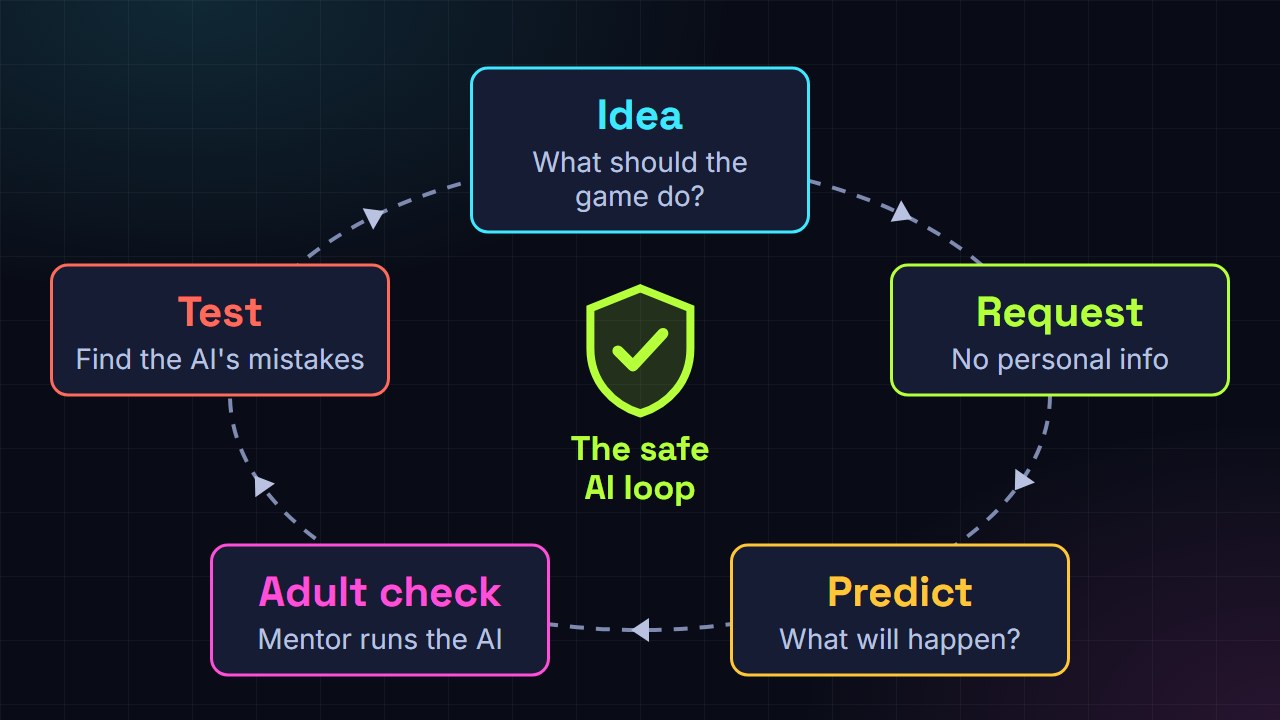
Most "AI for kids" courses are slideshows. Here, AI helps you build the games. You write the brain that can control the environment and the player: Python code is used to build the arena, makes decisions and remember what happened. Learn how to build with AI, carefully: a precise request that changes the real game, tested and run by the mentor, tested by the game, then tested by you. Knowing how far to trust AI - and how to check it - is the skill.
A brain that decides, remembers and adapts.
From lesson 1, your robot, fighter or player is driven by Python functions you write. It sees the world (positions, distances, armour, what the other players are doing), decides what to do, and remembers. That's a state machine, the same technique behind commercial games.
- Write a brain that chases, flanks, escapes when armour is low, or any strategy you can think of
- Beat the computer's own brains, from Easy to Expert
- Write code that adapts to the environment
- Decide your player's logic
Change the real game with AI. Then check its work.
Every member can ask for changes to their character, the environment, or the rules of the game. The request goes through the mentor, a test suite and a review before anyone uses it. That process is part of the lesson.
Mapped to what schools and exam boards now expect.
Learning outcomes are tracked in the games. They appear in every lesson, and every mission is recorded on the learner card.
Safe use of AI (AISAFE)
Write an AI request with no personal information and clear limits.
England KS3: use technology safely, respectfully, responsibly and securely, protecting online identity and privacy · KS4: how changes in technology affect safety · DfE: no personal data in generative AI tools making consideration for legal, social and ethical consequences.
Checking AI code (AIREVIEW)
Check AI-written code does what was asked, test it, explain it and say where AI helped.
DfE: AI content needs critical judgement to check accuracy · JCQ: verify and acknowledge AI use (tool and date) · Curriculum and Assessment Review 2025: use AI effectively without becoming dependent.
Straight answers about AI in the club.
Does my child talk to an AI chatbot?
What AI is used, and what does it see?
Isn't using AI to write code cheating?
Will this help with GCSE or A-level?
Could an AI change break the game or do something unsafe?
The taster includes a first AI request.
Your child asks for a change to their game; you watch what happens next.